Pages

Showing posts with label Science2020. Show all posts

Wednesday, 21 October 2020

Volcán de Colima 🌋

The Volcán de Colima, 3,820 m, also known as Volcán de Fuego, is part of the Colima Volcanic Complex consisting of Volcán de Colima, Nevado de Colima and the eroded El Cántaro. It is the youngest of the three and as of 2015 is one of the most active volcanos in Mexico and in North America


Where is it?

Volcán de Colima is located in Jalisco / Colima in Mexico. Jalisco is a western Mexican state fringing the Pacific Ocean. The state is known for mariachi music and tequila, both of which reportedly originated here. The capital, Guadalajara, is peppered with colonial plazas and landmarks like the neoclassical Teatro Degollado and regal Guadalajara Cathedral, with its twin gold spires. The neighbouring Palacio de Gobierno houses murals by Mexican artist José Clemente Orozco.


When did it last erupt?
The last time Volcán de Colima erupted was in May 11th 2019 for when it stopped later on July 12 2019. Yet it's last proper eruption was in January 2017.


Damage it has done?
There is no information on this except a photo of the hot rocks ruining the road. So I'm guessing since it's away from houses and stuff that it can only damage the nature and the roads.


How and when was it formed?
The currently active cone is within a large caldera that was probably formed by a combination of landslides and large eruptions. The lava is andesite containing 56-61% SiO2. About 300,000 people live within 40 km (25 miles) of the volcano, which makes it the most dangerous volcano in Mexico. 


Interesting Random Facts...
a. Colima volcano is one of the most active volcanoes in North America and 
one of the potentially most dangerous ones.

b. It has had more than 30 periods of eruptions since 1585, including several 
significant eruptions in the late 1990s.

c. It has had more than 30 periods of eruptions since 1585, including several 
significant eruptions in the late 1990s.


Myths / Legends about it?

The legend says that several centuries ago, in the years of the Mexican colony, king Coliman, governor of the region, and his faithful court members lived in his mansion on the outskirts of the volcano. After a discussion with his Spanish superior, Coliman and his followers were surrounded in his own mansion, their water and food supplies were cut, and they were told they’d be killed if they tried to escape.  They survived for several months but as they could not live for much longer and their death was inevitable, they all tried to escape one night, but they were discovered by the Spaniards. To avoid being captured, the king threw himself into the volcano along with his court members. Ever since, those who live in the region say that the volcano makes eruption when the descendants of king Coliman or his court are mistreated.


(Collect it this information from - This Website )


Some more Photos and Videos...


How does a volcano erupt? 
Volcanoes erupt when molten rock called magma rises to the surface. Magma is formed when the earth's mantle melts. ... Runny magma erupts through openings or vents in the earth's crust before flowing onto its surface as lava. If magma is thick, gas bubbles cannot easily escape and pressure builds up as the magma rises.


Effects of a volcanic eruption...
Further effects are the deterioration of water quality, fewer periods of rain, crop damages, and the destruction of vegetation. During volcanic eruptions and their immediate aftermath, increased respiratory system morbidity has been observed as well as mortality among those affected by volcanic eruptions.


Helpful Websites To Explore...

https://volcano.si.edu/volcano.cfm?vn=341040


https://www.volcanodiscovery.com/colima.html


+++++++++++++


The Experiment 


Since I got into my group we decided to do another volcano called Krakatoa which is located in Indonesia.


After we created our volcano (paper masque, newspaper and flour + water to create glue.) We painted it black so it looked like it at night time.  


Our explosion was okay we decided to use elephant toothpaste as the 'lava.' 


How we made elephant toothpaste was...

Method for elephant toothpaste...


What you need...


15mL of warm water

25mL of hydrogen peroxide 

3 spatulas of potassium iodine

Food colouring


The crafting...

Add 3 spatulas of potassium iodine into the warm water and stir


Meanwhile add the hydrogen peroxide, food colouring and soap (dishwashing liquid) into a bottle or a container - in our case the bottle of our volcano. 


Next, lightly mix around the hydrogen peroxide mixture.


Then add the warm water into it and watch it form elephant toothpaste.


Thursday, 10 September 2020

Marshmallow Catapult Shooter 🥳

Aim
To make a marshmallow shooter and work out what forces are acting on it.


Equipment...
Paper cup, scissors, a balloon and a marshmallow.


Method:

a. Cut out the bottom of the cup.

b. Cut off the neck of the balloon

c. Stretch the open end of the balloon over the bottom of the cup.
d. Place the marshmallow in the cup.

e. Pull balloon back to fire the marshmallow.


Results...
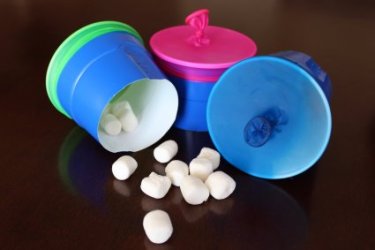
It looked like the photo below, except it was hard to put the balloon onto the cup, I say you should use a plastic cup. It did work but it wasn't as impressive. 


Discussion...
The forces acting were gravity, support, thrust and drag at the start when it was in the cup due to it not moving. 


Conclusion...
It did work but not that well, I think it could of been better if the cup was plastic but other then that it worked.


Grandma's Briefs — Home — How to make a marshmallow shooter


Wednesday, 24 June 2020

Metals and Acid 🧪

Metals and Acid

When a metal reacts with an acid, the same types of products are always formed.

Metal + Acid ➡️ Metal Salt + Hydrogen 


Testing for Hydrogen Gas

Aim: To show that hydrogen gas is produced when a metal reacts with acid.

Equipment: A test tube, a boiling tube, Bunsen Burner, a wooden splint, a bottle of acid, a piece of metal, safety glasses.


Method:

1. Light your Bunsen burner.

2. Add your sample of metal to your test tube. Add 2 mL of acid.

3. Carefully invert the boiling tube above the test tube containing the metal and acid. (as shown in the diagram below.)


4. Hold the test tubes together for a few minutes, allowing time for the inverted boiling tube to fill with gas.

5. When you think the tube is full, your lab partner should light a wooden splint.

6. Carefully, but quickly, tilt the boiling tube full of gas upwards and insert the burning splint into the mouth of test tube.


Observations:

It made a high pitched pop noise and it was warm in the test tube.


Outline how you could tell a chemical reaction was occurring in the test tube...

Because of the fast reaction and that noise that happened...


Discussion...
Basically, it was a chemical reaction, that caused the noise due to the gas reacting with fire.


Conclusion...
It was a pretty cool experiment but the popping noise kept scaring people.

Some Videoes...


Thursday, 11 June 2020

Making Indicators 🧫

Acid And Bases

Making Indicators 

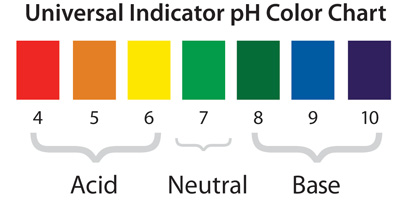
The P H Scale And Universal Indicator - Lessons - Tes Teach

Aim: To make acid-base indicators using everyday substances.

Equipment: Red cabbage, tea, beetroot, turmeric, cranberry juice, a beaker, water, tripod, Bunsen burner, gauze mat, 1.0 moI L1.0 moI L-1 HCI 1.0 mol L-1 NaOH. 


Task One

For Cabbage and Beetroot 

Chop the cabbage into small pieces until you have enough to fill 2 cups.

Place the cabbage in a large beaker and add water to cover the cabbage.

Boil over a Bunsen burner for at least ten minutes for the colour to leach out of the cabbage.

Filter out the plant material to obtain a red-purple-bluish coloured liquid. This liquid is at about pH 7. (The exact colour you get depends on the pH of the water.)

Place in a small beaker and leave to one side.

Repeat this method for the beetroot.


For The Tea

Put 100 ml of water into a beaker and boil.

Turn off the Bunsen burner and put three tea bags in the beaker.

Remove the tea bags when the tea is very strong.

Place in a small beaker and leave to one side.


For The Cranberry Juice

Pour into a beaker and leave to one side.


For the Turmeric 

Mix 1 teaspoon turmeric in 100 mL cup of alcohol.

Place in a small beaker and leave to one side.


Universal Indicator Scale' Photographic Print - Andrew Lambert ...


Task Two

1. You now have five beakers, each containing a different indicator.

2. Using a pipette, place 5 mL of the cabbage indicator into two test tubes.

3. Add 5 ml of HCI (acid) to one test tube and 5 mL of NaOH (alkali) to the other test tube.

4. Record the colour change on the table below. 

5. Clean the test tubes and repeat for the beetroot, tea, cranberry and turmeric indicators.

Universal Indicator Photograph by Andrew Lambert Photography

Results


Indicator
Colour in HCI (Acid)
Colour in NaOH (alkali) 
Cabbage 
Red
Green
Beetroot
Red
Yellow
Tea
Orange
Black
Cranberry Juice 
Orange
Green
Turmeric 
Yellow
Red

(I have no idea why it went black??)

Testing pH 🥼

Acid And Bases

Testing pH

pH SCALE AS AN INDICATOR - ACIDS AND BASES
(Acidic is acid and alkaline is a base)
Water is neutral. 


Aim: To test the pH of a range of household chemicals. 

Equipment: A variety of household chemicals, spotting tile, red litmus paper, blue litmus paper, Universal indicator solution, and safety glasses.

Method:
The method for this experiment is quite easy, surprisingly it's only three simple steps... 


Step 1 
Add a few drops of each chemical to a spot on your spotting tile. If a substance is solid or powdered you will need to mix it with a few drops of water before testing.


Step 2
Test the chemicals with litmus papers.


Step 3 
Test each chemical with a few drops of Universal Indicator.


And there you have it that's how you test the pH levels of household chemicals. Pretty easy isn't it? Make sure you record your results and compare them to your hypothesis.

Science Source - Universal indicator

My Results 

Chemical Being Tested
Colour in blue litmus
Colour in red litmus 
Colour in Universal Indicator
Fabric Softener 
Red
Red
Orange
Vinegar 
Red
Red
Red
Floor Cleaner 
Violet 
Violet 
Green
Dishwash Power
Blue
Blue
Blue
Toilet Cleaner 
Red
Red
Red

Conclusion 

Chemical Being Tested
Acid or Base?
Evidence from investigation
Fabric Softener 
Acid
Because it turned red which is indicating that it’s acid.
Vinegar 
Acid
When the indicator touched the vinegar it went straight to red.
Floor Cleaner 
Base
Due to it turning blue.
Dishwash Power
Base
Turned violet which is the colour of a base
Toilet Cleaner 
Acid
The results were red.

Indicators - Acids and Bases

Thursday, 28 May 2020

Model Atom ⚛️

In science, we have created a model atom, first, we had to pick an atom from 3-10 on the periodic table. I chose carbon and we had to find out how much protons, neutrons, and electrons it had. The equipment used was 1 piece of card, 30cm of string, blue tac, coloured beads, tape and scissors. The method was to stick the protons and neutrons (beads) on the blue tac, I choose silver and red beads. Cut out rings from the paper (we folded it in half and drew half circles then cut them out.) Then we had to draw electrons onto the rings. We also had to create a label onto the string. Soon we had to let it hang off a cupboard. Carbon has 6 so we had to put 6 beads onto the centre and draw 6 electrons (2 in the inner ring and 4 on the outer.) Ion formation would be loose because it would just have to lose four. In the end, it worked and I'm sorry if this doesn't make sense- 

Carbon Atom Atoms - Free image on Pixabay

Friday, 20 March 2020

Famous Scientist 🧪

Thomas Edison 

Image result for thomas edison


What are they famous for?
Thomas Edison is known for creating the light bulb, the phonograph (like a record player), the motion photo camera and as well as improving the telegraph and telephone. 


Phonograph;

Image result for whats a phonograph


Basic Information...
Thomas Alva Edison was an American inventor and businessman. It is known that Edison developed many devices in fields such as electric power generation, mass communication, sound recording and motion pictures. Surprisingly Edison didn't learn to talk until he was almost four years old and in 1954 at the age of seven, he had attended school for a short period of 12 weeks. The reason why is because he was a hyperactive child and prone to distractions, Edison's teachers could not handle him. His mother had then removed him for the school and tutored him at home until the age of 11. An interesting fact is that Edison even had a chance to improve his hearing (by an operation) however, he refused to take the option because he simply did not want to go through the difficulty of relearning how to channel his thinking in a noisier world. Then in 1876, he set up his first lab located in Menlo Park, California. This was the world's first industrial research laboratory. In some sense, this laboratory is also considered one of his greatest inventions. It was well equipped and is where Edison worked to change the world. Edison's first invention in Menlo Park was the tin foil phonograph. He was invited to demonstrate it to the president of the United States - Rutherford B. Hayes - in the White House.


Image result for thomas edison light bulb


What effect did he have on science today?
In my opinion, he had an effect on science today because he basically invented energy sources and how they worked. So basically when he made the light bulb he made history then. 


Image result for thomas edison light bulb

Tuesday, 10 March 2020

Smoking 🚬

Image result for smoking

Smoking? Over 1 billion of the human race do it, cigarettes are smoked every day and due to 1 billion people who do it this is nearly 20% of the world's population in 2014. About 800 million of these smokers are permitted to be men. In fact, on average a person who smokes lifespan is 10 years less than a nonsmoker. So what really goes on in the world of smoking? Let's find out...


What does smoking do to your body?
Smoking is very harmful to your physical well being and mental well being. A single cigarette puts 5,000 chemicals into your body that enhances the risk of cancer. Also, stuff called tar ruins your teeth by turning them black/brown and your teeth begin to eat away your teeth causing cavities. Smoking also has control over your sense of smell. Why? Well because one it irritates the nasal passages often causing inflammation that affects a person's sense of smell. Smokers of cigarettes containing menthol (a toxic, colourless, flammable liquid alcohol) may also find it affects their sense of smell. According to studies, this is why many smokers are 'thin.' They simply cannot taste or smell anything so food does not taste good to them. The reason why smokers cannot taste is because their taste buds are less sensitive. Cigarettes also weakens the skin's blood circulation and can increase the likelihood of acne and other skin infection. Among women, smoking can increase the male hormone (testosterone) sometimes leading to excessive hair on the face and arms. Smokers also have bad breath and it can cause gum disease and cancer of the mouth and throat. Most people know that smoker's lungs are the worst thing that gets affected. The lungs get filled with smoke and it makes breathing more difficult and it feels like you are breathing with your hand over your mouth and nose. In my opinion smoking damages, your lungs the most and a smoker gets the risk of getting lung cancer (it increases). Also, smoking is way worse for blood flow/circulation (CO kicks off O2). Since smoking messes with blood it would also mess with the heart. Why? Well, it restricts the blood vessels making the risk of heart disease four times more likely and even higher risks of a heart attack. Nicotine the thing in cigarettes lowers your body's defense system against bad bacteria and can lead to higher chances of stomach cancer. For the woman who smoke this could mess with pregnancy especially if you are pregnant, you are exposing the baby to chemicals that could lead to the death of the unborn baby.


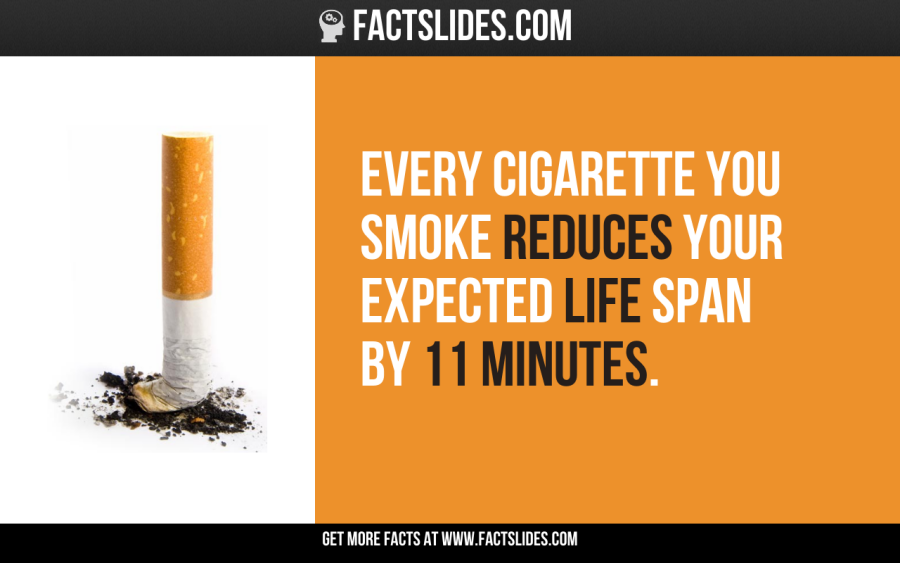
Image result for smoking facts


What are the long term effects of smoking?
The long term effects of smoking is something serious. Even if you quit smoking you will never return to how you or your body was before smoking (non-smoker.) One long term effect is breathing, your breathing gets bad because of all the smoke you have put into your body. Also, you have increased chances for cancer, heart attacks, strokes and brain damage. Another thing people experience is yellow teeth, tooth decay or even bad breath, loss of taste and smell, blindness, yellowing of white eyes and possible hearing loss.


Image result for smoking facts


Benefits of giving up smoking...
The benefits of giving up smoking is you let your body repair itself (the best it can) slowly. You also tend to not cough as much as if you were when you did smoke. The thing is with your body repairing itself this means there is a process of 20 years. Even after 12 hours without a cigarette, the body cleanses itself of the excess carbon monoxide for the cigarettes. The carbon monoxide level returns to normal (carbon monoxide is a type of gas or CO), increasing the body's oxygen levels to the blood circulation. Just one day after quitting smoking the risk of a heart attack begins to decrease.


Image result for smoking


Is vaping any better than smoking?
That's a simple question, no it is not good for your body but yes it is a little bit better than smoking. Vaping still has it effects especially on the lungs. Studies have shown that lung damage are in people who vape and even some deaths. The vapor contains harmful chemicals and very fine particles that are inhaled into the lungs and exhaled into the environment. To sum it all up Vaping may lead to lung inflammation (irritation) so it is still very bad for yourself and the body.

Image result for is vaping better for you than smoking


In general, smoking & vaping are bad for you.
Especially your health.
And the body.


Image result for smoking facts

Thursday, 27 February 2020

Heart Attack 💘

Heart Attacks

----
---
--
-
Image result for heart
-
--
---
----

What causes one?
Why heart attacks happen is mainly due to your heart getting blocked think of it like a sink getting blocked up. That's exactly what a heart attack is but just in a human except your coronary arteries become blocked. Over time a coronary artery can narrow from the buildup of various substances such as cholesterol. The coronary artery causes most heart attacks but not all and it's when fat deposits (plaque) restricts blood flow. Also, another way a heart attack can be caused is by the food you eat. These 'foods' being sugar, salt, and fat. Over time high amounts of salt, sugar, saturated fat (like butter) and refined carbs can raise your chances higher for a heart attack or even stroke. 


Coronary Artery
Just a disclaimer coronary arteries are the blood vessels (arteries) of circulation which transport oxygenated blood to the substance of the heart. It carries oxygenated blood because the heart needs a continuous supply of oxygen to function and survive just like many other tissue or organs of the body. 


Cholesterol
Cholesterol is a type of fat that is in your blood. Most cholesterol is made by your body but eating fatty foods (sugar, butter) can head to high cholesterol levels. Your arteries may get clogged up with the due to it which means you would either have a heart attack or stroke. 


Image result for heart


How do you know you're having a heart attack?
For my first guesses, I think you would suffer a horrible chest pain right above your heart. Except, the common heart attacks signs and symptoms include: pressure, tightness, pain or a squeezing/aching sensation in your chest or arms that may spread to your neck, jaw or even your back. Other symptoms of heart attacks can be nausea, indigestion, heartburn or abdominal pain. Other way you may know you might be having a heart attack is because you have shortness of breath (hard to breathe.) 


How do you prevent a heart attack?
Ways you could avoid a heart attack or even help recover for one is to void smoking, control your blood pressure and cholesterol levels, get regular medical checkups, exercise regularly, maintain a healthy weight, eat a heart-healthy diet and control stress. These are some ways but I believe there are many more ways that will definitely keep you on your own to feet to avoid these horrible things but the key one would be to eat healthily and look after yourself. Also, put your needs first before others.

Image result for heart


Heart dissection...
 So yesterday (26/2/2020) our class dissected a sheep's heart. When we first got the heart it was very slimy and quite squishy but tough. We had to find the thick side of the heart and the thin side. The reason why is because we had to cut into the thin side so we could open the heart like a book so we could see inside it. Then the fat and muscle were to basically cushion the heart and protect it. The valves are basically to control blood flow in and out of the heart I suppose you could call it like a road. The mitral valve and tricuspid valve control blood flow from the atria to the ventricles and the aortic valve and pulmonary valve control blood flow out of the ventricles. The two holes at the top of the heart are the aorta and super vena cava, the aorta is basically the main part of the heart and we saw that in our dissection. Now we did a sheep's heart but a pig's heart is closet looking to a human's heart because it is split up into parts and easy to see the different parts of the heart. 


Our disection (sheep heart)
no humans were harmed in the disection.

Image result for heart diagram


2 weird animal heart facts...
a. Hummingbird's heart rate can soar up to 1000 beats per minute in some species.
b. A blue whale's heart is as big as a compact car.


Image result for heart attack